Tuesday, 14 June 2016


Legal ivory sale drove dramatic increase in elephant poaching, study shows

Monday 13 June 2016 14.00 BST by
Damian Carrington
Research shows the legal sale in 2008 catastrophically backfired – but two African nations want to repeat the stockpile sell-off
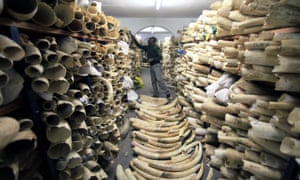
Zimbabwe is seeking permission to sell off its 93-tonne ivory stockpile that is worth about $15m. Photograph: Tsvangirayi Mukwazhi/AP

A huge legal sale of ivory intended to cut elephant poaching instead catastrophically backfired by dramatically increasing elephant deaths, according to new research.


The revelation comes just months before a decision on whether to permit another legal sale and against a backdrop of more African elephants being killed for ivory than are being born. In 2015 alone, 20,000 elephants were illegally killed.

The international trade in ivory was banned in 1989 but, in 2008, China and Japan were allowed to pay $15m for 107 tonnes of ivory stockpiled from elephants that died naturally in four African nations. The intention was to flood the market, crash prices and make poaching less profitable.

But instead, the legal sale was followed by “an abrupt, significant, permanent, robust and geographically widespread increase” in elephant poaching, concluded researchers Prof Solomon Hsiang at the University of California Berkeley and Nitin Sekar at Princeton University, whose work was published on Monday.

“We now have pretty striking evidence that these sales can be catastrophic. It backfired in a very bad way,” Hsiang told the Guardian. “I used to be a big proponent of legalisation in general to reduce the adverse effects of black markets. But through doing this work I have realised you have to be much more cautious. My own views have changed dramatically.”

The researchers think the legal sale reduced the stigma of ivory, boosting demand, and provided cover for the smuggling of illegal ivory, boosting supply. So, while the price of ivory fell after the legal sale, poaching increased.

The trade in threatened animals is governed by the Convention on International Trade in Endangered Species (Cites), a treaty agreed by 181 nations and the European Union. Its next summit in September will vote on a proposal from Zimbabwe and Namibia for another legal sale.

Prof Christopher Alden, at the London School of Economics, who is not involved on the new analysis, said: “The linkage [of the 2008 sale] with the surge in poaching is a sound one based on rigorous scholarly research.”

“The likelihood that the proposal from Zimbabwe and Namibia will produce a similar effect is therefore a very strong one,” Prof Alden said. “The specious arguments being made by proponents of once-off sales are, I am afraid, ill-disguised and self-serving.”


He said it was true that the elephant poaching crisis in east Africa has yet to hit southern Africa as hard, but that it was very likely to do so if a new sale was allowed: “[The proposal] is deeply disingenuous and one which flies in the face of the contemporary moves by China and the US to shut down the market for ivory.”

The new analysis was possible because poachers do not hide or destroy the carcasses of the elephants they poach. “It’s not worth the trouble,” said Hsiang. “So they’ve basically left us a complete and visible record of their activity.”

The 2008 ivory sale also corresponded with a 70% rise in the seizures of illegal ivory. The surges in poaching and seizures occurred right across Africa and the researchers checked for other factors that might have been involved, such as an increase in Chinese workers in Africa or rising affluence in China or Japan.

“We looked for alternative explanations in the data, but the best evidence still indicates that the legal sale exacerbated the destruction of elephant populations across Africa,” Sekar said.

Hsiang does not blame Cites for the backfiring of the sale, which was approved by a unanimous vote of its member states: “Before the sale, many economists has said it was the right thing to do. We think Cites were doing the best they could. Our work is intended to support future policy.”

A spokesman for Cites said: “The secretariat does not argue for or against the one-off sales. These decisions were taken by Cites [countries] in the context of the conditions that prevailed at the time. The secretariat welcomes this ongoing research and analysis and will continue to closely monitor all relevant findings.”

He noted that Cites monitoring of elephant poaching had not in the past seen a direct correlation between legal sales and increased demand in Asia. Hsiang said this might be because the data is smoothed to give long-term trends.

The Cites spokesman also noted that there had never been a one-off sale of rhino horn: “However, the spike in the number of rhinos poached for horn largely mirrors what has been seen with ivory. The illegal killing of rhino for its horn in South Africa alone increased from 13 in 2007 to close to 1,200 last year.”

An alternative to selling off stockpiles of ivory is to burn them, but this has also now come under scrutiny. On 30 April, Kenya burned 105 tonnes of ivory, making a total of 263 tonnes destroyed by 21 countries since 1989, mostly in the last five years.

But Duan Biggs, at the University of Queensland in Australia and writing in the journal Nature last week, said: “There is no published evidence so far that these events reduce poaching. Destroying ivory stockpiles risks a perverse outcome: ivory becomes rarer, fetching higher prices and increasing poaching and illegal stockpiling.”

“It is therefore crucial to track the effects of Kenya’s largest-ever ivory burn. Time is short and the stakes are high,” he said.

Hsiang said: “In policy, when we see things that are terrible, it’s natural to want to do something. But it’s important to remember that our actions might make them even worse.”

“Simple intuition is powerful and can sometimes get us really far in policy, but when incomplete it can also lead us into traps,” he said. “I am a complete advocate of looking into the data and determining whether these sorts of policies work. We need to carefully evaluate the effect and then be very open minded about the results.”

Citation: 
          Carrington, Damion. "Legal Ivory Sale Drove Dramatic Increase in Elephant Poaching, Study Says." The Guardian. The Guardian News and Media, 13 June 2016. Web. 14 June 2016. <https://www.theguardian.com/environment/2016/jun/13/legal-ivory-sale-drove-dramatic-increase-in-elephant-poaching-study-shows>.

Response: 
Like a lot of events in history, plans go awry. This legal sale of ivory in 2008 was suppose to help the situation of the illegal ivory go down, but instead it elevated it immensely. "The intention was to flood the market, crash prices and make poaching less profitable."To me personally, this is just going to make the illegal stuff look less illegal. If there is a legal sale, then this action is only going to make it seem OK to sell ivory, even if it is illegal. In the article they mention a statement that Kenya made my burning hundreds of tons of ivory. Their plan is to look into this data about the killing of elephants to see if this was an effective tool to use to ban the selling of ivory. I think this is a good idea: observing what will happen in the future years of Kenya's economy and the effect on the killing of elephants in East Africa. 

Tuesday, 7 June 2016

Light Sentence for Brock Turner in Stanford Rape Case Cause Outrage
http://www.nytimes.com/2016/06/07/us/outrage-in-stanford-rape-case-over-dueling-statements-of-victim-and-attackers-father.html

(I would of put the article here but it was giving me troubling copying it)


Response: 

After reading this article and a few others, including the victims letter, it makes me outraged and sad. I agree with the professor quoted in this article that the punishment given to Brock Turner was a mere "slap on the wrist". I think this article was meant to be for the people who are for the victim, but also those who think that Brocks sentence was enough. The author makes it out to seem like the dad's letter posted on Twitter a pathetic response to the destruction of the victims life. You can obviously see that titles, privilege, sex, had a role to play in Brock's sentence in that it was lessened because he was basically a good swimmber. You can obviously see my strong bias in this response.I think the objective of the article was so show what the Stanford freshmen and his family are going through but also show pieces of what the victim wrote in her 7000 word defense letter. 

Citation:

           Stack, Liam. "Light Sentence for Brock Turner in Stanford Rape Case Cause Outrage." The New York Times. NYTimes, 6 June 2016. Web. 7 June 2016. <http://www.nytimes.com/2016/06/07/us/outrage-in-stanford-rape-case-over-dueling-statements-of-victim-and-attackers-father.html>.

Tuesday, 10 May 2016

Brazil Reels Again as Impeachment Vote Is Declared Invalid
By

SIMON ROMEROMAY 9, 2016


RIO DE JANEIRO — The effort to oust President Dilma Rousseff of Brazilwas thrown into chaos on Monday when the new speaker of the lower house of Congress annulled a vote to impeach her, immediately upending the power struggle gripping Latin America’s largest country.


The surprise move came just two days before the Senate is expected to decide on whether to suspend Ms. Rousseff, replace her with the nation’s vice president and put her on trial.


Senate leaders vowed to defy the decision on Monday, promising to decide the president’s fate this week anyway. Lawmakers on both sides of the issue said they would rush to the Supreme Court, hoping for an answer on whether the impeachment proceedings would move forward as planned.


And Brazilians were left, yet again, trying to make sense of the maneuvering by their scandal-plagued leaders.


“Do you know what the world is now thinking of us Brazilians?” Joaquim Barbosa, a former chief justice of Brazil, asked in a Twitter message. “Many must be seeing us as a laughingstock.”


The battle over impeachment is happening at a time when Brazil is reeling from multiple crises, including its worst economic downturn in decades, the Zika epidemic and an enormous corruption scandal engulfing the national oil company.


At the same time, the nation is preparing to hold the Summer Olympics in Rio de Janeiro, a city grappling with a brutal crime wave and doubts over the safety of infrastructure projects built around the Games.


But for months, the main fight in the nation has focused on Ms. Rousseff, who faces accusations that she borrowed money from state banks to plug budget holes, masking the depths of Brazil’s economic troubles to bolster her re-election prospects. Before the decision on Monday, few expected her to survive the vote in the Senate.


Now politicians are scrambling to determine how the decision might affect the president’s fate.


“Dilma’s government was on its deathbed, so anything like this that creates a mess could be positive for her,” said Thiago de Aragão, a political risk consultant in the capital, Brasília.


Mr. de Aragão cautioned that legal scholars and opposition figures were already mounting a formidable challenge to Monday’s decision.


“Nothing is settled right now,” Mr. da Aragão said. “The Supreme Court or the Chamber of Deputies itself will likely say this is invalid. But that doesn’t mean that chaos isn’t the word of the day.”


On April 17, lawmakers in the lower house of Congress chose overwhelmingly — with 367 lawmakers voting for impeachment, 137 voting against and seven abstaining — to send Ms. Rousseff’s case to the Senate, which will decide if she should be suspended and go on trial.


But that process was thrown into question on Monday by Waldir Maranhão, a previously obscure lawmaker who took the helm of the Chamber of Deputies last week after the Supreme Court ordered his predecessor to step down to face a graft trial.


Mr. Maranhão contended that procedural rules had been broken in the impeachment vote against the president last month. He said the lower house should hold a new one.


Leaders in the Senate signaled that they had no plan to reschedule their vote on whether to suspend Ms. Rousseff on Wednesday. Raimundo Lira, the senator at the helm of that body’s impeachment commission, said that Mr. Maranhão’s decision had no “practical effect.”


Similarly, Renan Calheiros, the leader of Senate, called Mr. Maranhão’s move a “joke with democracy.” He said he would disregard it.


“The decision has no value whatsoever,” said Ronaldo Caiado, a senator from the conservative Democrats Party. “It’s just an act of the government’s desperation and five minutes of fame for the guy in charge.”


Ms. Rousseff responded to Monday’s decision by urging “caution,” saying that she did not know what the impact would be, while some of her supporters embraced it.


“We know that the impeachment process wasn’t done in the right way,” said Benedita da Silva, a lawmaker from Ms. Rousseff’s leftist Workers’ Party. “We hope that Maranhão will stay firm in his decision.”


Many of the nation’s leaders were already preparing for Ms. Rousseff’s suspension.


Michel Temer, the vice president who broke with Ms. Rousseff and is the country’s leader in waiting, has been seeking to assemble a cabinet in recent weeks, drawing potential ministers largely from his centrist Brazilian Democratic Movement Party and the opposition Social Democrats.


Now, many are trying to decipher the motivations of Mr. Maranhão. He was known as an ally of Eduardo Cunha, the scandal-plagued politician who oversaw the effort to impeach Ms. Rousseff. Last week, Mr. Cunha was removed as speaker of the Chamber of Deputies by the Supreme Court, putting Mr. Maranhão in the driver’s seat.


“Friends, I have a doctorate in this business, but I don’t have the faintest idea about what’s going on,” Maurício Santoro, a prominent political scientist in Rio de Janeiro, said in a Facebook post.


Some questioned whether Mr. Maranhão was seeking to shore up political support in his home state in northeast Brazil, which is governed by an ally of Ms. Rousseff. Others questioned whether Mr. Cunha had played a role in Monday’s decision.


Mr. Cunha, the deposed speaker, said on Monday that he disagreed with Mr. Maranhão’s decision. Referring to Brazilian news reports speculating about whether he had a hand in the move, Mr. Cunha said, “I condemn the insinuations of any nature published by unscrupulous journalists about any role of mine in this episode.”


Mr. Maranhão has faced claims that he was not fit to take the helm of the lower house, which would place him next in line for the presidency if the vice president takes over. Like Mr. Cunha and dozens of other high-ranking politicians, Mr. Maranhão is facing claims that he took bribes in the enormous graft scheme surrounding the national oil company, Petrobras.


“You’re going to be surprised by me,” Mr. Maranhão told fellow lawmakers last week.


Ronaldo Macedo Jr., a law professor at Fundação Getúlio Vargas, an elite university, said he expected Mr. Maranhão’s decision to be struck down.


“I don’t think that this decision by Maranhão will prevail,” he said, pointing to previous decisions by the nation’s highest court. Mr. Macedo emphasized that justices had already approved the impeachment proceedings carried out in the lower house.


In a speech to the lower house on Monday, Mr. Maranhão defended his decision, calling it an effort to “save democracy.”


Citation:
               Romero, Simon. "Brazil Reels Again as Impeachment Vote Was Declared Invaild." NYTimes. The New York TImes, 9 May 2016. Web. 10 May 2016. <http://www.nytimes.com/2016/05/10/world/americas/brazil-dilma-rousseff.html?_r=0>.


Response: I think this is interesting subject that's happening in Brazil now. I had to read up on what is going on before I could post and respond to this. Basically what I found out was that Brazil is struggling in a lot of areas: sickness, scams, economy, impeachment, and the coming up Olympic Games in Rio. They have got a lot on their plate. But this article was involving the vote in the senate to suspend the current President Dilma Rousseff. She is suspected of being involved with a corruption scandal by stealing from an oil company Petrobras to fund her persidential campaign. Also she is accused of breaking the law by making the economy look better than it actually was doing by misstating the 2014 deficit. Both of these examples are illegal and she will be sent to trial. But when the court was getting ready to vote, the vote was declared invalid by the Lower Houses' new representative. The process will still continue but it has sent it into an uproar. 

Tuesday, 3 May 2016


Homology Medicines Emerges with Next Generation Gene Editing Technology Driven by Industry-leading Team in Rare Diseases
- Completes $43.5 Million Series A Financing and Appoints Leadership and Scientific Advisory Board -
May 02, 2016, 07:30 ET from Homology Medicines, Inc.
LEXINGTON, Mass., May 2, 2016 /PRNewswire/ -- Homology Medicines, Inc., a newly formed genetic medicines company translating proprietary, next generation gene editing and gene therapy technologies into novel treatments for patients with rare diseases, today announced the closing of a $43.5 million Series A preferred stock financing co-led by 5AM Ventures and ARCH Venture Partners. Additional investors included Temasek, Deerfield Management, and ARCH Overage Fund.  In conjunction with the financing, Homology hired biotechnology industry veterans who have a demonstrated track record in identifying and developing novel gene therapy and editing technologies, including Arthur Tzianabos, Ph.D., as Chief Executive Officer, Sam Rasty, Ph.D., as Chief Operating Officer, and Albert Seymour, Ph.D. as Chief Scientific Officer.  The Company also appointed an experienced Board of Directors and members of the Scientific Advisory Board.
"It is rare to find cutting-edge science that takes a fundamentally new approach placed in the hands of experts who have worked together as a team before to translate new technologies into treatments targeting the underlying cause of serious genetic diseases," said Dr. Tzianabos. "We are convinced that this single technology platform, which enables in vivo editing by efficient gene transfer, has broad, unmatched capabilities.  With the strong support of our investors and advisors, we will rapidly advance novel treatments that have the potential to cure patients."        
Homology Medicines was founded and incubated with a seed investment within the 4:59 Initiative, the company creation engine of 5AM Ventures.  Homology is based on groundbreaking science that harnesses the naturally occurring process of homologous recombination.  This non-nuclease-based approach offers clear advantages in its precision, efficiency and on-target in vivoediting of genetic mutations.  Homology obtained an exclusive worldwide license to this technology platform, which is based on the pioneering research of Saswati Chatterjee, Ph.D., Department of Surgery, member of the Beckman Research Institute at the City of Hope in California and co-founder and Chair of Homology's Scientific Advisory Board. Dr. Chatterjee is also a member of the Recombinant DNA Advisory Committee (RAC) to the Office of the Director, National Institutes of Health (NIH) and former charter member of the Therapeutic Approaches to Genetic Diseases Study Section of the NIH.  Dr. Chatterjee and her team led the first adeno-associated virus (AAV) vector-mediated gene transfer studies into human hematopoietic stem cells and subsequently identified and isolated a series of naturally-occurring AAVs from human CD34+ cells.
"Homology's ability to attract top management, who over many years have gained scientific and practical knowledge of the complexities of developing treatments for rare genetic diseases, is a testament to the strength of our technology platform," saidKush Parmar, M.D., Ph.D., Managing Partner at 5AM Ventures and Homology Board member.  "The Company has an aggressive development plan and a significant opportunity to leapfrog current strategies in gene therapy and editing as it builds an expansive and high-value clinical pipeline."
Commenting on the launch of Homology Medicines, Steven Gillis, Ph.D., Managing Director with ARCH Venture Partners and Homology Board member, noted, "As a scientist and investor, I have evaluated many breakthrough technologies in this field and I believe Homology's technology platform is unique in its ability to leverage naturally occurring genetic mechanisms to both treat and correct diseases in vivo.  I look forward to helping Homology lead the next generation gene editing technology that could result in new curative medicines for life-threatening diseases."  
Citation: 
          "Homology Medicines Emerges with Next Generation Gene Editing Technology Driven by Industry-leading Team in Rare Diseases."Homology Medicines Emerges with Next Generation Gene Editing Technology Driven by Industry-leading. Ed. Homology Medicine. Homology Medince Inc., 2 May 2016. Web. 03 May 2016. <http://www.prnewswire.com/news-releases/homology-medicines-emerges-with-next-generation-gene-editing-technology-driven-by-industry-leading-team-in-rare-diseases-300260438.html>.

Response:
I think its great that they have a new technology for rare diseases. I think this will finally be the answer to the diseases and illness that are just exist because the genes lines are broken up and need to be "unmutated". This is also a natural process, so its not something that will cause potentially more harm to the person. This is an amazing step in medical history and the science of curing diseases. If this breakthrough is for real, then rare diseases will be soon eradicated. 

Monday, 25 April 2016

Target boycott pledge reaches half a million signatures
By Bradford Richardson - The Washington Times - Monday, April 25, 2016
In less than five days, more than 500,000 people have signed a petition pledging to boycott Target over the retail giant’s policy allowing restroom access on the basis of gender identity.
In the wake of a controversial law in North Carolina regulating public accommodations on the basis of biological sex, the company released a statement last week reiterating its pro-LGBT position. Target said it welcomes “transgender team members and guests to use the restroom or fitting room facility that corresponds with their gender identity.”
“Everyone deserves to feel like they belong,” the statement said. “And you’ll always be accepted, respected and welcomed at Target.”
In response to the declaration, the American Family Association on Wednesday started a petition calling for shoppers to boycott Target until it changes the policy.
“Target’s store policy endangers women and children by allowing me to frequent women’s facilities,” the petition says. “Until Target makes the safety of women and children a priority, I will shop elsewhere.”
The petition has received 506,329 signatures.
The boycott plan was spearheaded by Texas Rep. Louis Gohmert, a Republican, who last week announced on the House floor that he would no longer shop at the retail giant.
“I understand Target may now be changing their restrooms,” Mr. Gohmert said on Thursday. “If they’re going to be having women come into the men’s restroom, I won’t be going to Target to shop, unless and until that changes.”
Mr. Gohmert said the policy allows sexual predators and voyeurs access to restrooms of the opposite sex simply by declaring to identify as the opposite gender.
“It’s already been shown, you give guys a chance to say, ‘I’m transgender, and I get to go in and film a girl in the shower.’ There are people that do that,” he said. “Why not let the transgender LGBTQRST — whatever the initials are — let them have their activities where they don’t impose on the privacy of someone who wants to go to the restroom?”
The boycott comes as more than 100 big businesses have threatened to curtail commercial activity in North Carolina if the bathroom law is not repealed.
Richardson, Bradford. "Target Boycott Pledge Reaches a Half a Million Signatures." The Washington Times. Washington Times, 25 Apr. 2016. Web. 25 Apr. 2016. <http://www.washingtontimes.com/news/2016/apr/25/target-boycott-pledge-reaches-half-million-signatu/>.

Response: I chose this article considering our unit and though this very interesting. This article is pretty straight forward though. No obvious bias or slant, but the others opinions that Richardson chooses to put in this article are biased against the LGBT community and Target's reiteration of their inclusivity. Mr. Gohmert especially has a lot of insulting things about assuming every transgender individual wants to do other things besides use a restroom in peace like everyone else. But I can see the argument from the parents and shoppers, especially for families of small kids. But I think people judge a lot by the appearance of someone looking unusual or different. But if this law is not going to repelled, shoppers need reassurance that they are safe going to the bathroom; such as extra security and cameras and even recommendations that kids under a certain age should not go the restrooms by themselves. So I can definitely identify with both sides of this disagreement. 

Tuesday, 8 March 2016


Israel's Netanyahu rejects US 'surprise' at Obama talks cancellation

Israel's prime minister has rejected a White House claim that it was surprised by his decision to turn down the offer of talks with President Barack Obama.

US officials complained on Monday that they had learnt via the media that Benjamin Netanyahu had cancelled a planned visit to Washington next week.

But Mr Netanyahu's office said Israel's ambassador had said on Friday there was a good chance he would not be visiting.


Relations between Mr Netanyahu and Mr Obama have long been strained.

Last year, the White House accused the Israeli leader of a breach of diplomatic protocol after he arranged to address a joint session of Congress without consulting or notifying the president.

He used the speech to urge US lawmakers to reject the nuclear deal with Iran, which he viewed as a danger to Israel.

'Erroneous reports'


Mr Netanyahu had been expected to visit Washington to address the annual conference of the American Israel Public Affairs Committee (Aipac).

The White House said the prime minister's office had proposed two dates for talks with Mr Obama and that one of them worked with the president's schedule.

"We were looking forward to hosting the bilateral meeting," Ned Price, a spokesman for the White House's National Security Council, told reporters. "We were surprised to first learn via media reports that the prime minister, rather than accept our invitation, opted to cancel his visit."

Mr Netanyahu's office initially declined to comment, but on Tuesday it issued a statement stressing that Israeli ambassador Ron Dermer had informed the White House on Friday that there was "a good chance" that Mr Netanyahu would not be visiting Washington and that a final decision would be taken on Monday.

"On Monday, news reports suggested that the PM would not be travelling to Washington and erroneously stated that the president was unwilling to meet with the PM," the statement said.

"The [prime minister's office] immediately corrected the erroneous news reports and officially informed the administration that the PM would not be coming to Washington."

It added that Mr Netanyahu had wanted to avoid interfering in the US presidential primary elections that are taking place and that he would now address the Aipac conference via satellite link.


The dispute comes ahead of a visit to Israel by US Vice-President Joe Biden.

Mr Biden will arrive later on Tuesday and hold talks with Mr Netanyahu on Wednesday.

They are expected to discuss a new US military aid package, with Israel reportedly seeking substantially more than the $3bn (£2.1bn) a year it currently receives.


Citation:
"Israel's Netanyahu Rejects US 'surprise' at Obama Talks Cancellation." BBC Middle East. BBC, 8 Mar. 2016. Web. 8 Mar. 2016. 
Response: 
This article was very fact based but we can pick out some bias it as well. I see bias against the US by the author (not mentioned) says that the US 'accused' the Israeli PM of scheduling a meeting with the senate without President Obama's previous consent. Mr. Natanyahu seems very disrespectful: not honoring his appointments, and not communicating with the president directly. President Obama had to find out through social media that he wasn't coming to Washington. Instead, the Vice President has to go there to have a meeting with him. It sounds like he is also lazy. But despite all this, this article is not overly biased against the Israeli PM.

Tuesday, 1 March 2016

Calais 'Jungle' camp: clashes as authorities demolish homes

Police fired teargas at migrants who threw stones and set fire to shelters after dozens of makeshift shacks were dismantled. 
Clashes between police and migrants continued into Monday evening after authorities moved in earlier in the day to dismantle parts of the refugee camp known as the Jungle.
The homes of up to 200 people of the approximately 3,500 people living in the camp had been demolished by the middle of the day, according to a British refugee aid group, as smoke went up from blazes engulfing makeshift shelters.
Some homes appeared to have been set alight by the heat of teargas canisters fired at crowds by riot police, said a spokeswoman for the British volunteer group Help Refugees, while some residents seem to have set others on fire in protest.
Video footage from a volunteer inside the camp showed residents running away from clouds of teargas. Reuters said police fired teargas at about 150 people and activists who threw stones, and at least three shelters were on fire.
The clashes continued into the evening near a motorway heading to the port of Calais, where vehicles were blocked by migrants on the stretch of road overlooking a piece of ground which had previously been part of the camp.
Strewn with debris, the port road was eventually taken back by police, who arrested one person and three members of the No Borders activist group.
The work began in the early morning, with orange-vested work crews dismantling several dozen makeshift wood-and-tarpaulin shacks by hand before two diggers loaded the debris into large trucks. Police in riot gear shielded the work, and initially there were no reports of unrest beyond a report of one British activist being arrested.
Volunteer groups said the work began with officials telling residents they had an hour to leave before their home was demolished.
Reacting to the demolitions, Amnesty International said that both the French and UK governments had to live up to responsibilities in relation to those who were evicted, including facilitating access to asylum proceedings in France and visas to the UK for those with family members there.
“Although it’s taking place across the Channel, this is not an issue that the UK can wash its hand of,” said Amnesty International’s Europe and central Asia director, John Dalhuisen. 
The prefecture of Calais, which late last week won a court battle allowing demolition to begin, wants to clear large parts of the southern part of the site on dune land just west of the town’s busy docks. It adjoins the road leading to the ferry terminal, a draw for those seeking to smuggle themselves on to trucks bound for the UK.
Volunteer groups have warned that moving people from the camp will do little but disperse many elsewhere around Calais. A UK-based group, the Refugee Rights Data Project, said that of the 460 residents asked what they would do if the camp was dismantled, 80% said they would remain in Calais or move to a more basic refugee encampment in nearby Dunkirk.
The study suggested authorities’ plans to evict people “is unlikely to provide a viable solution to the current humanitarian crisis on our doorstep”, said Marta Welander, the founder of the project.
Of those who lost their homes on Monday, some had moved into space elsewhere in the camp, Help Refugees said, while others had been seen carrying sleeping bags into Calais. “We don’t really know yet what people will do, but it seems likely some will just be dispersed to other areas around Calais,” a spokeswoman said.
Clare Moseley, of Care4Calais, another British volunteer group, said prefecture officials arrived at the camp at 7am and gave residents an hour’s notice to leave or face arrest. “The police presence is massive,” she said. “They have the whole area cordoned off.” French media reported that about 40 vans of riot police were in position near the site. 
Help Refugees said some of its volunteers had been blocked on Monday morning from entering the camp, home to refugees and migrants from countries including Syria, Afghanistan, Sudan, Eritrea, Iran, Pakistan and Egypt.
A spokeswoman said the demolition began in a section of the camp with a mostly Iranian population: “People were being told they had to leave,” she said, “Otherwise they would be arrested. A lot of people seemed quite confused.”
A spokesman for the Calais prefecture denied there was a vast new clearing operation under way. He said French officials from asylum agencies and other state agencies would continue to go from tent to tent to talk to talk to migrants about their options, as they had done last week.
He said: “There is a reinforced police presence today to allow those officials to enter and talk to people. But this is a gradual process which will take place over several days and weeks. There will be no bulldozers.”
Fabienne Buccio, the head of the Calais prefecture, said three-quarters of the homes in the southern part of the camp were now empty after officials encouraged residents to leave over recent days.
Police were needed, she said, in case what she described as “extremists” tried to stop migrants accepting offers of new accommodation or buses to centres elsewhere in France.
French authorities said earlier this month they intended to bulldoze half of the main camp, warning between 800 and 1,000 migrants and refugees to leave a seven-hectare southern section of the site. Buccio previously told Le Monde she intended to reduce the size of the camp by about half.
Care4Calais is among the groups that have opposed the dismantlement plans in the French courts. A legal appeal against last Thursday’s ruling had been lodged last week, Moseley said, and was expected to be heard soon.
A Help Refugees spokeswoman said Monday’s work did appear to be the start of wider clearance. “That’s what it’s looking like. They did say it’s going to be slow and respectful, giving people options, and I suppose they have in a way. But at the same time they’re not giving people access to information. One person was seen being given their options as their shelter was being dismantled, so the respect they talked about last week isn’t really happening.”
While some residents have moved into shipping container shelters and a small number have left on state-provided coaches to centres elsewhere in France, many more than the official estimate of 800 to 1,000 people remained inside the main camp. A census carried out by two charities recorded 3,455 people living there, with one group telling the Guardian this week that this included 445 children, of whom 305 were unaccompanied.

Citation: 


             Chrisafis, Angelique, Peter Walker, and Ben Quinn. "Calais 'Jungle' Camp: Clashes as Authorities Demolish Homes." The Guardian. Guardian News and Media, 01 Mar. 2016. Web. 01 Mar. 2016. <http://www.theguardian.com/world/2016/feb/29/french-authorities-begin-clearance-of-part-of-calais-jungle-camp>.


Response:


This article written on March the 1st describes the events that took place when the police starting to demolish many of the refugee homes in Calais, France. The author is clearly biased toward the refugees. In several ways he makes it seem like this was not the refugees fault at all but the way the police gives no mercy when they start to start fire to shelters. In the article, it reads that the migrants started to riot and throw stones after the police came, but then this was followed by the police teargasing the camp. The author mentions that the teargas was what presumably started some of the fires in the camp. Even when the aid organizations such as Care4Calais and Help Refugees were trying to help by coming into the camp, they were not permitted through. The police injustice even goes as far as to give the migrants other lives options right in front of their home, while its being destroyed. Chrisafis, Walker and Quinn end the article by underlining the fact that there were children still living in the camp: 305 of the 445 were without parental supervision. I think the objective of the article is to see how the riot police forced thousands of migrants from their homes unnecessarily.


Monday, 22 February 2016

Tunisia probes deaths of 

countryman in US airstrike 

in Libya


TUNIS, Tunisia — Tunisian authorities on Monday authorized an investigation into the deaths of Tunisian citizens in last week’s U.S. airstrike on an Islamic State group training camp in neighboring Libya.
A court spokesman, Kamel Barbouche, said the green light for the probe into Friday’s attack on the camp near Sabratha, not far from the Tunisian border, was given because most of those killed were Tunisian nationals. Local Libyan officials said more than 40 people were killed and many others injured. The strikes targeted Tunisian extremist Noureddine Chouchane, the Pentagon has said.
There was no certainty that Chouchane was killed.
The Tunisian probe aims to find out, via DNA, who is dead and who is still alive and, once identified, whether they are implicated in terrorism or other cases under judicial review, Barbouche said by telephone. Survivors also will be questioned, he said.
The investigation would help determine whether Chouchane was killed. He is wanted by Tunisia in the March attack on the Bardo museum outside Tunis. Some 60 foreign tourists were killed in that attack and a June attack on a resort hotel in Sousse.
The U.S. strikes on the training camp fueled Tunisian concerns about an eventual military intervention in Libya by coalition members. Authorities have ramped up security at the Libyan border. Tunisia has a border of some 500 kilometers with Libya, which has spiraled into chaos.
A leading opposition party, Al Joumhouri, fears Tunisia, struggling on the road to democracy despite economic troubles and attacks, could become collateral damage in a military intervention in Libya. Party leader Maya Jribi said at a news conference that such a scenario would be “catastrophic for Tunisia, for the entire region.”
Bouazza, Bouazza Ben. "Tunisia Probes Deaths of Countryman in US Airstrike in Libya." Washington Post. The Washington Post, 22 Feb. 2016. Web. 25 Feb. 2016. <https://www.washingtonpost.com/world/africa/tunisia-probes-deaths-of-countryman-in-us-airstrike-in-libya/2016/02/22/39ad52e8-d990-11e5-8210-fbd8de915f6_story.html>.